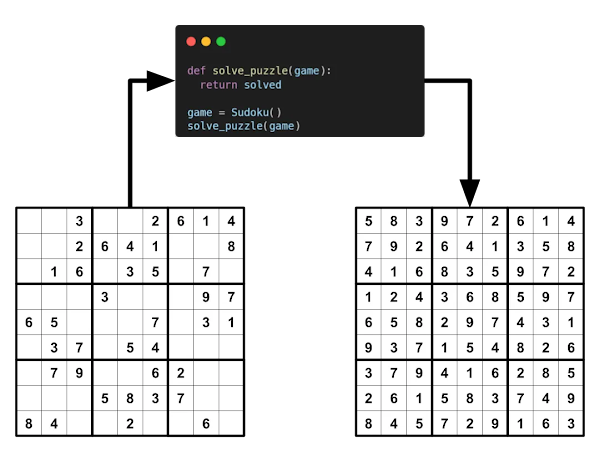
How to Solve Sudoku - A Comprehensive Guide

To solve a Sudoku puzzle, fill the 9×9 grid so that every row, every column and every 3×3 box contains the digits 1 to 9 exactly once. You do it in a fixed order: first scan for naked singles and hidden singles, then cross-hatch each digit box by box, then use pencil marks to find naked pairs and pointing pairs, and only on hard grids reach for X-Wing. Every valid Sudoku is solvable by pure logic — you never need to guess.
This is the complete guide to solving Sudoku, from the rules to the advanced techniques, in the order a real solver actually uses them. If you get stuck on any grid, our free Sudoku solver gives you the full solution in under a second.
The rules of Sudoku in thirty seconds
A standard Sudoku puzzle is a 9×9 grid divided into nine 3×3 boxes. Some cells are already filled — these are the givens or clues. Your job is to fill the rest.
There are exactly three constraints, and they never change:
- Each row of nine cells contains the digits 1 to 9, each once.
- Each column of nine cells contains the digits 1 to 9, each once.
- Each 3×3 box contains the digits 1 to 9, each once.
That is the whole game. There is no arithmetic in Sudoku — the digits are simply nine distinct symbols, and the puzzle would work identically with nine letters or nine colours. A correctly built Sudoku puzzle has exactly one solution, reachable by logic alone.
The order to solve Sudoku in
Most people who struggle with Sudoku are not missing a technique. They are applying techniques in the wrong order, spending effort on complex methods when a simple scan would have handed them three digits.
The correct order, cheapest first:
- Naked singles. A cell where only one digit can possibly fit. Free placements — take them all before anything else.
- Hidden singles. A digit that can only go in one cell of a row, column or box. This is where most easy Sudoku puzzles are solved.
- Cross-hatching, digit by digit. The systematic sweep that finds every hidden single without hunting.
- Pencil marks, then naked pairs and triples. Only once scanning has stopped producing results.
- Pointing pairs and box-line reduction. Interactions between a box and a line.
- X-Wing, Swordfish, colouring. Hard and expert grids only. Most puzzles never need them.
Always drop back to step one after each placement. A single digit often unlocks a cascade of naked singles, and searching for an X-Wing when a naked single is sitting on the board is wasted time.
Naked singles: the free digits
A naked single is a cell where eight of the nine digits are already blocked by its row, its column and its box. Whatever is left is forced.
To find one, pick an empty cell and read its three units. If you can account for eight different digits between them, the ninth belongs in that cell.
Naked singles are most common in the fullest regions of the grid. A row with seven digits already placed, or a box with six, is where to look. On an easy Sudoku, chaining naked singles alone can carry you a long way.
Hidden singles: the technique that solves most puzzles
A hidden single is the reverse question. Instead of asking what fits in this cell, you ask: within this box, where can the 4 go?
If eight of the nine cells in a box are blocked for the digit 4 — because a 4 already sits in their row or column, or the cell is filled — then the remaining cell must be the 4, even if that cell could also accept other digits.
This is the single most productive technique in Sudoku. The overwhelming majority of easy and medium puzzles are solved with hidden singles and nothing else. It is also why cross-hatching matters: cross-hatching is simply the systematic way of finding every hidden single.
Cross-hatching: how to scan without wasting time
Cross-hatching turns hidden-single hunting into a mechanical process.
- Pick one digit — start with the digit that already appears most often on the grid.
- Find every existing copy of that digit. Mentally strike out the full row and full column of each one.
- Look at each 3×3 box that still needs the digit. Count the cells not struck out and not already filled.
- If exactly one cell remains, write the digit there. If two or more remain, move on — do not guess.
- Finish the digit across all nine boxes, then move to the next digit.
Working one digit at a time is what makes this fast: you hold a single digit in mind for the whole sweep instead of reloading nine candidates at every cell. Starting with the most frequent digit matters too, because a digit that appears seven times already blocks seven rows and seven columns and is often forced immediately.
Pencil marks: when and how to use them
Pencil marks (also called candidates or notes) are the small digits you write in a cell to record what could still go there. They are essential on hard Sudoku and a waste of time on easy ones.
Marking a whole grid before you start costs about ninety seconds of writing, and on an easy puzzle you will never need most of those marks. The efficient approach is staged: scan first, mark later, and mark only where you are stuck.
Once marks exist, keep them accurate. A stale candidate that should have been erased will eventually lead you to a wrong placement, and a wrong digit in Sudoku stays invisible for another ten moves before it produces a contradiction you cannot trace.
Naked pairs, triples and quads
A naked pair is two cells in the same row, column or box that both contain exactly the same two candidates — say 3 and 7, and nothing else.
You do not know which cell holds the 3 and which holds the 7, but you know those two cells consume both digits between them. Therefore 3 and 7 can be erased from every other cell in that unit.
The same logic scales. A naked triple is three cells in one unit whose candidates come from the same three digits; those three digits leave every other cell in the unit. A naked quad extends it to four. Triples do not require every cell to hold all three digits — cells holding 2 of the 3 still count, as long as no fourth digit appears among them.
Hidden pairs
A hidden pair is the mirror image: two digits that can only appear in the same two cells of a unit. Those two cells must hold those two digits, so every other candidate in those two cells is eliminated. Hidden pairs are harder to spot but often break open a stalled grid.
Pointing pairs and box-line reduction
These two techniques exploit the interaction between a 3×3 box and a row or column.
Pointing pairs (and triples). If, inside one box, a digit can only appear in cells that all sit in the same row, then that digit must be in that row somewhere within the box. It can therefore be eliminated from that same row in the two neighbouring boxes.
Box-line reduction. The reverse. If, within one row, a digit can only appear in cells that all sit inside a single box, then that digit belongs to that box in that row — and it can be eliminated from the rest of that box.
Together with naked pairs, these two are the workhorses of medium and hard Sudoku. Learning to see them on sight is worth far more than memorising exotic strategies.
X-Wing and beyond: hard Sudoku techniques
An X-Wing works on two rows at once. If a digit has exactly two possible positions in one row, exactly two in another row, and those positions sit in the same two columns, then the digit occupies opposite corners of that rectangle either way. It can be eliminated from both columns everywhere else.
Swordfish is the same idea across three rows and three columns. Simple colouring chains a digit that has only two possible cells in several units, following the alternating true/false links until a contradiction appears.
These are genuinely useful on expert grids and almost never needed below that level. If you are reaching for an X-Wing on a medium puzzle, you have almost certainly missed a hidden single.
A complete worked solve, step by step
Techniques listed separately are hard to apply. Here is how they fit together on a real grid, in the order they actually occur.
- Count the digits. Five seconds. Suppose 5 appears seven times, 9 six times, 1 twice. You will start with 5.
- Cross-hatch the 5. Strike the rows and columns of every existing 5. Two boxes now have a single free cell each. Write both 5s.
- Follow the consequences. Each new 5 changes its row, its column and its box. Check those three regions before looking anywhere else — often another digit is now forced there.
- Move to the 9, then the next most frequent. Repeat the sweep. Placements from the 5 have changed what the 9 can do.
- Second full pass. Sweep all nine digits again in the new frequency order. The grid is fuller, so cells that were ambiguous are now forced. On an easy Sudoku the puzzle usually finishes here.
- Pencil-mark the emptiest unit. If placements have dried up, mark just one box or one row — never the whole grid.
- Look for a naked pair. Two cells with the same two candidates remove those digits from the rest of the unit, which usually creates a hidden single elsewhere.
- Check boxes against lines. Pointing pairs and box-line reduction. This is where medium becomes hard.
- Return to step 2. Every elimination creates new scanning opportunities. Never stay in advanced mode when a simple sweep would now work.
That loop — scan, harvest, mark, eliminate, scan again — solves everything up to expert level.
How to read a Sudoku grid quickly
Read units, not cells
Beginners look at one cell and ask what fits. Experienced solvers look at a row, a column or a box and ask what is missing. A row with seven digits placed has two blanks and two missing digits; that is a two-second deduction, not a nine-way comparison.
Read bands of three boxes
Because a digit appears once per row, three horizontally adjacent boxes constrain each other tightly. Looking at the band rather than the box turns three separate searches into one glance, and it is what makes pointing pairs visible without hunting.
Work where the grid is dense
Constraints concentrate where digits already are. The emptiest box looks like the biggest opportunity and is almost always the worst place to spend attention.
Sudoku vocabulary you will meet
| Term | Meaning |
|---|---|
| Given / clue | A digit printed in the puzzle at the start |
| Unit / house | Any row, column or 3×3 box |
| Candidate / pencil mark | A digit still possible in a cell |
| Naked single | A cell with only one candidate left |
| Hidden single | A digit with only one possible cell in a unit |
| Cross-hatching | Eliminating by striking rows and columns of an existing digit |
| Bi-value cell | A cell with exactly two candidates |
| Elimination | Removing a candidate rather than placing a digit |
| Peer | Any cell sharing a row, column or box with another |
Sudoku by grid size and variant
The 9×9 grid is standard, but the same logic scales in both directions.
- 4×4 — digits 1 to 4, 2×2 boxes. Used to teach children the three constraints.
- 6×6 — digits 1 to 6 with 2×3 boxes. A genuine step up from 4×4 without the full difficulty of 9×9.
- 9×9 — the standard grid. Everything on this page assumes it.
- 16×16 — digits and letters, or hexadecimal. Identical logic, far more bookkeeping.
- Sudoku X — both main diagonals must also hold 1 to 9, adding two units.
- Killer Sudoku — cages with sums replace the given digits. See our Killer Sudoku guide.
- Wordoku — letters instead of digits. Mathematically identical.
- Samurai — five overlapping 9×9 grids sharing corner boxes.
Some numbers behind the puzzle
- There are 6,670,903,752,021,072,936,960 valid completed 9×9 grids.
- Allowing for symmetries and relabelling, 5,472,730,538 are essentially different.
- The proven minimum number of clues for a unique solution is 17, established in 2012 by exhaustive computer search.
- The maximum number of clues that still leaves the puzzle non-trivial is 77.
- Each row, column and box sums to 45 — the basis of every Killer Sudoku technique.
- There is no arithmetic in standard Sudoku; the digits are nine distinct symbols.
Difficulty levels and what each one requires
| Difficulty | Techniques required | Typical time |
|---|---|---|
| Easy | Naked singles, hidden singles, cross-hatching | 2–5 min |
| Medium | Above + pencil marks, naked pairs | 5–10 min |
| Hard | Above + pointing pairs, box-line reduction, hidden pairs | 10–25 min |
| Expert | Above + X-Wing, Swordfish, colouring | 25–60 min |
Difficulty in Sudoku is not set by the number of givens. A grid with 26 clues can be far harder than one with 24; what decides it is which techniques the solving path requires.
The five mistakes that cost beginners the most
- Guessing. A guess that seems to work will collapse ten moves later, and by then you cannot tell which placement was wrong. Every valid Sudoku is solvable without guessing.
- Marking the whole grid immediately. Ninety seconds of writing you mostly will not use.
- Restarting the scan from the top-left after every placement. The next digit is almost always in the row, column or box you just touched.
- Forgetting to erase candidates. A stale pencil mark is worse than no pencil mark.
- Ignoring the box constraint. Beginners check rows and columns and forget the 3×3 box — the constraint that makes Sudoku a puzzle rather than a Latin square.
How to get faster at solving Sudoku
Speed comes from removing wasted looks, not from thinking faster.
- Always sweep a digit fully across all nine boxes before switching digits.
- Count the digits first and start with the most frequent one.
- After each placement, check that digit's row, column and box before looking anywhere else.
- Learn to read three boxes at once — a band or a stack — rather than one cell at a time.
- Never write a digit you cannot prove. Accuracy is always cheaper than a restart.
Frequently asked questions
How do you solve a Sudoku puzzle step by step?
Scan for naked singles, then hidden singles, then cross-hatch each digit across all nine boxes. Only when scanning stops producing placements should you add pencil marks and look for naked pairs, pointing pairs and box-line reduction. X-Wing and Swordfish come last, on expert grids only.
What are the rules of Sudoku?
Fill the 9×9 grid so that each row, each column and each 3×3 box contains the digits 1 to 9 exactly once. There is no arithmetic involved, and a valid puzzle has exactly one solution reachable by logic.
What is the easiest way to solve Sudoku for beginners?
Cross-hatching. Take one digit, strike out the rows and columns where it already appears, and look for a 3×3 box where only one free cell is left. Start with the digit that appears most often on the grid.
What is the difference between a naked single and a hidden single?
A naked single is a cell where only one digit can fit. A hidden single is a digit that can only go in one cell of a row, column or box, even if that cell could accept other digits. Hidden singles solve most easy and medium Sudoku puzzles.
Do you ever need to guess in Sudoku?
No. A properly constructed Sudoku has exactly one solution reachable by logic alone. If you feel forced to guess, you have missed an elimination — check for hidden singles, naked pairs and pointing pairs before assuming otherwise.
When should I use pencil marks?
Only after two full cross-hatching passes have stopped producing placements, and then only in the single emptiest box or row. Marking the whole grid up front costs about ninety seconds and is unnecessary on easy puzzles.
What is a naked pair in Sudoku?
Two cells in the same row, column or box that both contain exactly the same two candidates. Those two digits are consumed by those two cells, so both can be eliminated from every other cell in that unit.
What is a pointing pair?
When a digit inside one 3×3 box can only appear in cells of a single row or column, that digit is eliminated from the same row or column in the two neighbouring boxes. It is one of the highest-value techniques for hard Sudoku.
What is an X-Wing and when do I need it?
A digit with exactly two possible cells in each of two rows, aligned in the same two columns. It can then be eliminated from those columns elsewhere. You need it only on hard and expert grids — on easier puzzles a hidden single has almost certainly been missed.
Does the number of given clues decide the difficulty?
No. Difficulty depends on which techniques the solving path requires, not on clue count. A 26-clue grid can be harder than a 24-clue one. The proven minimum for a unique solution is 17 clues.
How long should it take to solve a Sudoku?
Roughly 2–5 minutes on easy, 5–10 on medium, 10–25 on hard and 25–60 on expert for a competent solver. Fast solvers finish an easy grid in under 90 seconds.
How can I check whether my Sudoku solution is correct?
Every row, every column and every 3×3 box must contain the digits 1 to 9 exactly once, with no repeats. To verify instantly, enter your grid into our free Sudoku solver and compare.
Start solving
Take any grid, count the digits, and cross-hatch the most frequent one through all nine boxes before writing anything else. Work up the technique ladder only when the cheaper step stops paying. And whenever a puzzle beats you, our free online Sudoku solver gives you the complete solution instantly.